Sunday, May 23, 2010

An Epic Day with Alligator Airways and the Barramundi Shuffle

         (actual bomb casings from the WWII Bombing)
We woke before the sun was up and chased it to bed – it was one of those Epic days – like three or four all rolled into one. We’d been asked by the Alligator Airways mob to be up and waiting by 5:15 AM for our ‘Works’ trip to King George Falls, the Kalumbra Mission, Mitchell’s Falls and home again. If the weather was right we intended to do an afternoon trip to the Bungle Bungles as well. The bus took its time coming for us but eventually did show and took us to the airstrip for our eagerly anticipated adventure. We essentially had our own plane – a Cessna 210 with a maximum ground speed of 300 kms/hr. As we became airborne I could tell it was going to be an incredible day of sight-seeing. The light was just coming up over the Ord River valley and the patchwork quilt of various plantations lay out before us beckonning us onward. We could spot crocs in the river and later, once out on the coast, hordes of sea turtles, dugongs and more crocs along the shoreline. Our first destination was the King George Falls – only viewable by boats or plane. Although it’s always nice to be able to venture in by vehicle or foot to these incredible natural formations, seeing it from the air was extravagant. We continued on to Kalumbra – an isolated aboriginal mission in the middle of nowhere. It sits inland from the coast about 40 kms and is populated by about 600 people – primarily of Aboriginal descent. To give some perspective – the Kimberley is about the size of Victoria (3 x the size of Spain) and has about 30,000 people total – in other words it is a massive landmass with virtually no people living in it due to its inaccessibility and essentially uninhabitable terrain. What it also means is there is a plentitude of untarnished, unadulterated natural surroundings – absolutely unbelievable to see – especially from the air. Initially we didn’t know what to expect of Kalumbra – we’d never heard of it and were primarily interested in viewing the various falls, coast and gorges. It was a fascinating place! The aboriginal community actually looks fairly functionable with tidy yards and more or less well cared for homes. The inner sanctum of the little village is immaculately manicured and holds the church and adjacent buildings where the Father of the mission lives and runs his own museum. He is a most affable and unassuming gentleman with an incredibly amusing guffaw that he tends to add to the end of the stories he recants – sort of a guttural ‘ha ha!’ peaking in pitch and sound towards the end of the last ‘ha’. The mission was actually bombed in WWII by the Japanese, killing one of the former priests and a number of the aboriginal civilians. Pieces of the bombs and carnage have been kept and put on display. They’ve rebuilt what was destroyed and retained a number of other artefacts from the war years which have been added to an immense collection of worldly treasures acquired by Father McPhee himself. Given his interest in ‘curating’ he eventually set up a museum in the village and has organized the various collections interspersed with Aboriginal artefacts to try to imbue a sense of pride amongst the local Aborigines – demonstrating that their culture and history is on par with the rest of the world. The church was intriguing as well with a definitive attempt to meld the Aboriginal world-view and conceptual history with that of the Catholic Church’s traditions. The cross is depicted over a background of aboriginal paintings and one wall has a mural with symbols of the church interspersed with those of the Aboriginal dreamtime stories and mythologies – amazing.


From Kalumbra we flew to Mitchell’s Falls, a massive two-tiered fall with immense cascades falling a good 60 to 100 metres to the water below. We circled it a few times just to take it all in and get a few good snaps. From there we were homeward bound and climbed through and above the clouds to enjoy the cooler air. A short snooze (the air gets quite thin up there) and rude awakening when we were about to land and we were back at the airstrip. We had a quick spell back at the caravan park for lunch and a swim, then ventured out for our afternoon trip to the Bungle Bungles – something we’ve been irking to see since coming to the area. Although we’d seen a few gorges and taken in a bit of the Gibb River Road, we didn’t feel we’d really done the Kimberley. The Bungle Bungles are an entirely unique rocky formation some 53kms in from the Great Northern Highway along a nefarious, and currently closed, 4WD track. The formations look like multi-coloured cylindrically stripped bee-hives and look perfectly rounded or moulded by the forces of erosion – absolutely out of this world sort of breath-taking. A renowned gorge also exists in the area called Cathedral Gorge and although our pilot attempted to give us a sense of its majesty, it’s just not one of those things you can experience from the air so regrettably we weren’t able to appreciate it in all its grandeur. The trip also took us over Lake Argyle – the largest ‘man’-made lake in the world as well as the Lake Argyle Diamond Mine – again – the largest of its kind in the world. If I heard over the head phones correctly, it was discovered rather incidentally and harbours a seam of diamonds that is 600 metres below the surface, about 1.5 kms in length and covers an expanse of 45 hectares – or something close to this. We were very impressed as it had those massive dump trucks with the wheels as big as houses (costing a good $100,000 plus to replace). As the sun was setting over the horizon we finally landed and made our way back to town. Our final adventure for the day was an Aboriginal night of entertainment entitled the Barramundi Concert held in conjunction with the week’s festivities of the Kununurra Muster. It was hosted inside at the local leisure centre due to the weather over the past week so wasn’t quite as nice as if it were outdoors. All in all, we thought it would be a bit more than it was. The acts/performers were average and surrounding chaos of kids running amok almost too much to handle. A fashion show was almost offensive not only in the way the ‘models’ chose to dress themselves – something akin to what you’d see in the red light district of any major city, but also in how the crowd seemed to react to them prancing up and down the stage – if the music was a bit more racy you almost would’ve expected them to start shedding their garb right then and there. Cole won himself a t-shirt in the melee – demonstrating his best modelling swagger for the cross-dressed and very cynical but sincere MC. Exhausted from the long day with over 140 photos on the card, we collected ourselves and trudged home to our sweaty caravan, ready for our next port of call – Katherine and beyond!


Saturday, May 22, 2010

The Big Croc of Wyndham, Skeeter bites at the Grotto and Mirima National Park

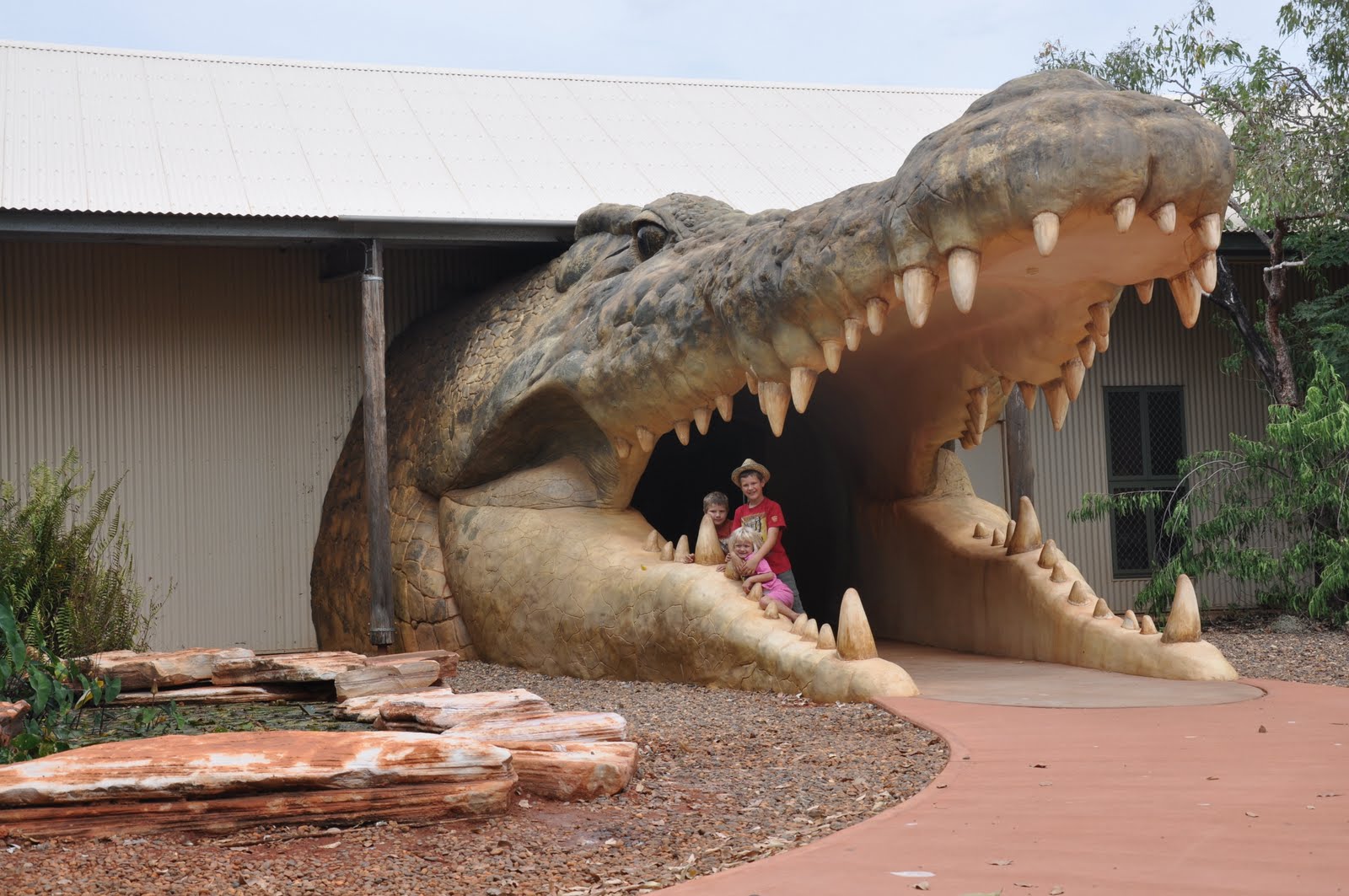
We woke to sound of rain drumming on our roof. Not just a little spitter spatter, but a full-on concerto of cacophony – another day of the drench had arrived. Full of optimism that it might clear we packed into Bessie and headed to Wyndham to put another tick on our Big Things of Australia map. Wyndham is home to the Big Croc, a massive model of a salt-water crocodile commissioned by the Lions Club. It essentially greets you as you enter town along a nature strip complete with picnic tables and a nearby toilet facility. It also sits almost directly in front of the local bottle shop and adjacent fast food outlet (owned by the same proprietor). As such, there were a good twenty aboriginals hanging out at the tables drinking fizzy drinks and feasting on chips waiting for the bottle shop to open. Tourists such as ourselves would filter through for a picture with the big croc then head on again without much ado. It was a rather sad state of affairs. Needless to say we didn’t stay long and after a short trip through town which appears to be in the slow process of inevitable demise, headed back down the road to the Grotto – a amphitheatre-like gorge just off the highway with a large pool at the base obviously used for swimming and cooling off on drier, hotter days. It was a great breeding area for mossies though and they seem to have an affinity for my ankles – must be sweeter blood down there. No one else seemed to have an issue – so perhaps it was just my blood they were after – must be in short supply. By the time we’d climbed back out, the rain had more or less abated so we made our way back to town stopping at the Zebra Rock Café and Gallery on the way home. The rocks were just as fascinating as at the Stoneworks with equally interesting carvings and designs. They also served mango smoothies and had a pier off which you could feed the turtles and catfish – great fun for the kids. From there we decided to hit the Hoochery – the oldest distillery in WA (apparently) and enjoyed some tasters of their standard and seriously overproof (68 %) rum as well as a touch of their chocolate and coffee liqueur (what a great combo!). The overproof did some serious chest warming and was actually quite smooth going down – would have picked up a bottle except that it would likely collect dust for years before we would likely even open it given our lack of affinity for the ‘heavy’ stuff. Besides, our closet is still full of wines we picked up in SA. As the afternoon dwindled we made our way to Mirima National Park on the outskirts of Kununurra. As we pulled up the drive I noticed something blocking the path and slowed to a halt – it was a frilled-necked lizard! Jen cautiously climbed out of Bessie to get a photo but it sensed her coming and ran on its hind legs to the adjacent fence and then up a tree. I tried in vain to get a photo of it on the tree but it continued to scamper away. We parked, found a pathway to the view point and made our way up past some amazing rock formations and natural scrub. The formations are touted to be similar to those in the Bungle Bungles but not quite as large or defined. Pleased with our efforts we finally made it back to the caravan park and settled down early for the evening. We’d booked ourselves a trip to Mitchell’s Falls in the morning and had to be up at 5 AM to get picked up from our caravan park. We were looking forward to an epic day and besides were exhausted from all our touring so sleep came quick and we dreamt of sunshine.


Friday, May 21, 2010

Thermal springs, Taking flip flops to their Limits and Racing the sun

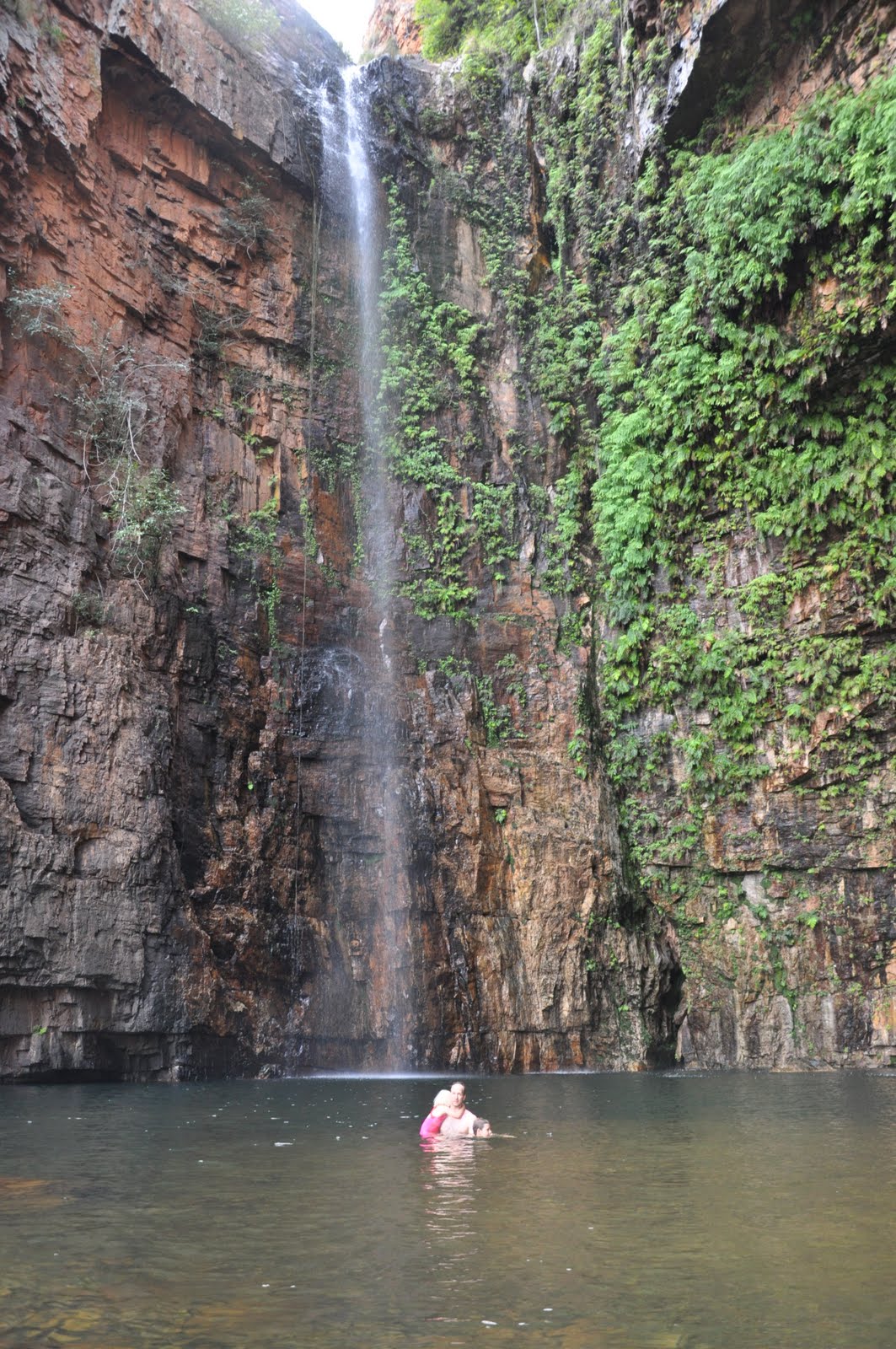
A day of sun had finally come and it was time for adventure. 60 odd kms out of town is the turn off for the Gibb River Road, a dirt track essentially connecting Derby with Kununurra and Wyndam – 500 plus kms. We’ve been seeing hordes of brown-caked FWDs – literally wearing the wet Gibb track from stem to stern and undercarriage to roof. The sort of mud and dirt you dream about wallowing in as a boy. We too wanted some of the action so headed in to see if we could make it to Zebedee Thermal springs. The road was actually not unlike some of the dirt tracks I’d driven during my tree-planting years with no serious creek/river crossings. Bessie had no problems whatsoever. The thermal springs were a couple hundred meters in from the parking lot which held maybe 5 or 6 other vehicles. It was only open for general tourists from 6 AM until noon and we arrived at 11 AM, so only had a short time to enjoy them. It was a little surreal oasis with picture perfect clear water cascading down a gentle slope into some soaking pools with palm trees interrupting the flow in little islands of roots and moss. It was a great way to begin our little adventure session. Next we had to close our pores so headed back from whence we came, stopping at the trail-head for the Amalia Gorge . The hike in was a bit more involved and probably best done in a proper pair of hikers rather than flip flops – but flip flops was all we had. The crux of the hike was making our way around an outcropping of rock with about a foot or so ledge underneath. The kids did it on all fours with ease while Jen and I had to find a climbing hold and gently swing ourselves around. From there it was easy sailing and the lower falls (Ochre falls) opened up into a couple levels of crystal clear pools with cool but bearable water. We could have headed further up stream to the actual Amalia falls but that would have involved a fairly tricky little climb not really suitable for a 3 or 6 year old. The pools and falls were excellent where we were so we stayed put. A perenthine lizard perched itself on the main jumping rock over the lower pool and held it’s position for the duration of our stay so no major cliff jumping could be had. We still had another gorge to go so we headed back to Bessie and onward to the Emma Gorge Resort. Emma Gorge is located 1.6kms in from the resort – a pristinely landscaped little complex complete with pool and outdoor restaurant. We fueled up on ice cream and Powerade and headed in. The sign at the entrance to the path indicated no new starts after 3 pm – it was 2:50 pm – so we’d made the cut. Some returning walkers looked at our youngish crew and felt obligated to announce that the sun would be setting at 5 pm – seemingly a word of warning or discouragement – obviously didn’t know what family they were dealing with. With Piper on the shoulders we made good time and completed the inward journey in about 35 mins (forecasted in the guide to take an hour). The reward for our efforts was great - a towering 65 metre fall with a large pool at the base of vertical reddish-stoned walls, simply breath-taking. Piper, Aidan and I swam our way to the base of the falls and felt the water rain upon us. Cole was a bit more timid and came only half way out – not too sure about the deeper waters. Jen had forgotten her bathers so had to be the photographer and let the serene environment cool her down after the hike in. We made it back to the car with at least 10 minutes to spare before sunset, feeling spent after a massive day of ‘gorging’ ourselves on nature. We hadn’t seen it all though and hoped the weather-gods would be with us for at least another couple of days so we could do some more venturing about and feel we had done the Kimberleys justice.

Thursday, May 20, 2010

A boy named Mitchell, the Laundromat Blues and Mad as a cut snake!

We’ve been invaded. On arriving and setting up at our new caravan park, a young and gregarious boy around Piper’s age gradually crept closer and closer until he was fully engrossed in our ‘zone’ – his name was Mitchell. Caravan Parks tend to squeeze you in with virtually a metre or two at times between yourself and your neighbour. As such, if you’ve been on the road for sometime you tend to cling to your zone a bit, seemingly wishing to defend it as much as possible from incursion – it’s your space and with such limitations you don’t want to give any of it up. Our little friend Mitchell is at the age where social norms and boundaries have yet to be understood so he tends to venture over into ‘the zone’ willy nilly, occasionally even venturing inside the fortress uninivited – he’s innocent about it and curious but it gives you that nagging tension in your neck and urge to escort him gently back to his parents in the next camp over. The boys have met some other boys at the resort pool and their avidity for such social connection has brought home their isolation over the past few months. For an hour or so, they were in their element running amok capturing Princesses (Piper) and combating baddies to no end. The contrast of their behaviour was actually quite striking once out of the obviously controlled and uninfluenced confines of our small family unit – like small social experiments demonstrating the effects of a variety of other life experiences and propensity for testosterone to exert its rather boisterous tendencies on young boys. I felt like I was watching a documentary on SBS.
While the boys got to work on the day’s schoolwork, Piper and I set off to do the laundry and complete some errands. Aidan seems to be going through chapter books like they’re going out of style. Every new town with a bookstore gets a visit to keep up with his voracity. Cole’s reading is coming along with a recently noted spark of interest and confidence suggesting he’ll actually get into it as well. He hasn’t been as keen on schoolwork as Aidan, but I think the lights will go on and with a bit of concentrated effort (undistracted) he should go well once back into formalized school. I have a feeling he seems to have a propensity to be a bit of a rabble-rouser and will identify with other kids with the same outlook, shunning his work for play. Hopefully the school we’ve enrolled him in in Canada will cater a bit to his whimsical side and keep him on task and learning. Piper surprises us at times, sitting down flipping through some of her and the boys books. She virtually knows all of her nursery rhymes somewhat by heart (with a few 'Piper-isms' added in for effect and ownership). She joined me in our venture to the Laundromat at the local BP Service station. A clean little facility mainly used by visiting workers or travelers such as ourselves in search of a dryer! The weather has continued to be inclement with douses of rain showers negating the effect of short humid dry spells on hanging laundry. Not wishing to play in the parking lot or twiddle my thumbs for the duration of my washing/ drying loads, Piper and I took off to complete some errands. The first go around worked out swimmingly with perfect timing for a freed up dryer. Unfortunately our second mission went on a bit long and when we returned our clothes had been removed from their respective machines by others with nothing better to do but monitor the machines. Accepting our lot we headed out with ne'er an evil comment and went through the invigoration of hanging the semi-dry mass back at the caravan park.

In the arvo we headed out on bikes to the ski/swim beach out past the airport along a very nicely paved cycling track. Not sure why anyone would wish to swim or ski in the area as large crocs are touted to be seen occasionally. The kids played on the jungle gym a good 25 metres from the waters edge. There was actually a tree about 15 metres out with a rope tied to an upper limb which has obviously been used by local kids – looks a bit precarious to us conservative southerners. On the way back to the caravan park we stopped at a local Stone-smith shop to check out his wares. A variety of different silt rocks have been formed in the Kimberleys ranging from 1200 million year old ribbon stone (multi-coloured layered stone) to astronomite (burgundy stone with lighter coloured perfect circles or dots – like a petri-dish with bacteria cultures), zebra (perfectly evenly striped) and okapi stone (multi-coloured even stripes). We’d promised the boys a pendant necklace back in Broome but had forgotten to pick them up so managed to find a couple for them here. At a local café with one of the best arrays of gelato we’ve seen for quite a while, we feasted on some tasty flavours then headed home. There’s a term for crazy people in Australia – often applied to Queenslanders – “mad as a cut snake.” Crossing the street, a Caucasian man with a German-sounding accent was standing in front of the Centrelink office with mirrored windows, gazing at himself while he slapped his abdomen yelling, “Like concrete!” He fit the profile - very bizarre. Back at the van our friend Mitchell was nearly waiting on the doorstep. He was hard to dissuade or get rid of but eventually managed to make it back to his home/van for the night. We had a little movie after dinner and then settled for the evening with dreams of swimming holes, waterfalls and large gorges prancing in our heads.

Wednesday, May 19, 2010

Wet in the Dry, The Bungle Bungles washed out, Hell’s Crack, Turkey Creek and Kununurra

In the grand scheme of things we’ve actually been quite lucky as weather goes. Most of our trip has been rained upon by sunshine with the odd (and almost malevolent) exception (King’s Canyon to mention one). Now we’ve come up to north WA in the ‘Dry’ and ventured inland to where the main attractions lie – namely the Gorges, and there’s no access. Purnululu National Park where the Bungle Bungles stand in all their glory has been closed for the past week due to rains and undriveable dirt roads. It’s an interesting area of incredible rounded layered rocks – almost like a doodle someone has ventured upon while idly sitting at a board meeting or trying to pay attention to the intricate mechanisms of DNA replication in Bio 100. It’s also home to a few magnificent gorges and a natural cathedral which appears to tower over the lucky traveller who has been able to miss the muck and make it in. The road into the park is only 53 kms but is apparently booby-trapped by numerous treacherous creeks and riverbeds taking at least 2 hours to manoeuvre through. The area was unknown to the tourist world until the mid-80’s when some vacationers happened to be flying over and noticed the incredible geological formations. You can still fly in (when the park is open) via fixed-wing or helicopter but as is the norm, they usually want an arm and leg and perhaps your first born child to do so. We’ve looked into renting a rugged 4WD that might make it in but the weather is simply not cooperating and the chances of getting there before we need to head further eastward are slim to buckleys.


We’ve had a couple days of travel since the last blog, and ventured through Hell’s Crack (otherwise known as Hall’s Creek) and onward to Turkey Creek – otherwise known as – Warmun. At Hall’s Creek we stopped for lunch, groceries and a possible visit to the Chinaman’s Wall just outside of town along a dirt track. It’s a massive natural quartz wall representing a faultline in the earth and seemingly similar in some capacity to the Great Wall of China – hence the name. We made a bee-line to the information centre on entering town and when positing the question as to whether the road to the Chinaman’s Wall was open, detected a definitive guffaw from the staff – apparently its inaccessibility was a foregone conclusion given the unseasonal rains. A visit to the IGA Xpress was also enlightening. In true governmentally-sponsored gusto and with all the best intentions, the poster for the 5+2 Veggie, fruit nutritional awareness campaign was pasted just above the fresh fruit and veggie section. The problem was that the actual fruits and veggies themselves were exceedingly and prohibitively expensive. It seems a bit odd for such basic food items, deemed essential for a healthy existence should be priced so extravagantly when the very population needing it most (Hall’s Creek is predominantly Aboriginal) can hardly shake a nickel or dime together. It’s even more difficult to understand given that Hall’s Creek is along the main highway and trucking route in the area so shouldn’t have difficulty with supply issues. Ah the hypocrisy! On a favourable note we did manage to make it to the post office just before the lock out occurred at 1pm for lunch. The kids and Jen were idly looking at the numerous books and games so often sold at Australian Post when the woman working the till suddenly announced in quite a forceful and shrill manner that we needed to get out as the door was about to close. It caught us a little off guard as it was an odd occurrence for something to shut in the middle of the day here in Australia. She let me finish my business and then essentially shackled down the office with roller door and padlocks on the outer gate. Something wasn’t quite right in Hall’s Creek – not surprised it’s developed a more cynical nomenclature.


From there we made our way to the Turkey Creek Roadhouse a hundred or so kilometres further up the road. The aboriginal name and community adjacent to the roadhouse is the Warmun Community – famous for their particular style and method of Aboriginal artwork using actual ochre from the area. After yet another damp night in a rather muddy caravan area of the roadhouse, we woke early, hoping the weather was on its way to improving. We had a leisurely breaky and then made our way into the Warmun Community to their art centre. It’s your fairly typical government housing type of set up until you swing around the back of the community to their gallery – a modern, obviously recently built structure, ironically staffed by Caucasians from South Australia. Behind the incredibly beautiful façade of the building sits an older two story building where the artists gather to produce their paintings. The kids seemed bent on bouncing on whatever presented itself to them, full of vigour and energy after a couple days of travel and almost had to be restrained outside to stop them from bouncing off paintings worth several thousands of dollars. While Piper found a stage to practice her own personal version of ballet (a sort of hip hop, eighties pop kind of wiggle) and the boys ventured across to see the artists at work, Jen and I took turns appraising the works, aiming to find yet another to dress our dwindling and as yet non-existent wall space back in Canada. The curved shapes of landscape in bold earthy colours were mesmerizing at times and we eventually found one to our liking entitled “Crocodile Hole – Flat Rock” – an instant classic! Seriously – who could walk away from such a title! The earthy tones and large basic shapes are pretty catchy too and it will adorn our walls-to-be with much grace and appreciation.


Kununurra was close at hand, so we trekked onward with high hopes that the weather would clear and we’d find plenty to see and do for the next few days. I’ve been checking the weather daily on my iPhone but hadn’t (up until this afternoon) updated my location from Broome to Kununurra – assuming that they would have essentially the same forecast. While discussing our plans for renting a 4WD with the agent at Avis and showing him the wonderful images of suns in my Broome forecast, he shook his head – thinking to himself – “some more stupid Americans” and begrudgingly took our booking. Noticing his disconcerting apprehension about our planned journey I updated to Kununurra and found the skies filled with clouds and what looked like lightning strikes – not good. Fortunately, there are a number of places in the near vicinity which should be easy to get to in Bessie and offer some exciting geological displays – if all else fails – there’s always the Hooch Distillery a few kms out of town.


Sunday, May 16, 2010

Goodbye Broome, Hello Kimberley – you’re Gorges

For one last hurrah we decided to have dinner out at Azuki’s fusion Japanese Restaurant. Sheets of light rain had engulfed the area so the daily highs of 30 + temps had descended to the low 20’s – giving us all a relative chill. We had booked an outside table but fortunately it was covered for just such a weather situation. Directly next door to the restaurant was the fast food outlet called Chicken Treat which offered some interesting viewing due to the rain. Hordes of Aboriginals had collected here to get some shelter from the rain and a bite to eat. One thing must have led to another and sure enough the Police paddy wagon showed up and shouting erupted. It wasn’t quite ‘Cops’ of TV popularity but made for some interesting dinner time drama. The fare was comparable to our favourite sushi eatery in Sydney – Kobe Jones, with melt in your mouth sashimi, massive salmon and spicy tuna rolls and your classic Japanese dessert – Sticky Date pudding (with coconut ice cream) – that must have been part of the fusion theme. Back at the palace we furiously did one last clean up and then crashed in our lovely big beds for one last snooze in comparative luxury. It took us a few hours to pack up the caravan the next morning but still gave us time to hit the Courthouse Markets for a proper coffee, some smoothies and freshly squeezed fruit juice and a few maple syrup crepes. The rains persisted as we said our goodbyes to Broome en route to Fitzroy Crossing – about 400 kms up the road.


Fitzroy Crossing is a tiny little town predominantly populated by Aborigines. Its claim to fame is the Geike Gorge, 18kms out of town as well as the Fitzroy River which runs the length of the town and through the Kimberleys to the ocean. The Fitzroy drains about 70 % of the Kimberley Basin, which for the most part, used to be a massive coral reef some 50 million years ago (during the Devonian Era). The Geike Gorge – soon to be the Darbunga (or something close to this) Gorge – its aboriginal name - is demonstrative of the incredible limestone formations gouged out in sections by the river, wind and acidity in the rains. The textures and reliefs are amazing. When driving in to the area for a cruise along the river, we were struck by the almost animated look of the layered rocks – sure at any second they would come to life and clamber over to our vehicle to crush it under the weight of thunderous steps. We must be watching too many movies like the Transformers or Lord of the Rings. Some of the peaks of the formations appear to be almost suspended or precariously balanced on a precipice. The cruise up the river, although a tad damp from the spitting rain, was beautiful, with the boat very nearly undercutting areas of the cliffs which towered some 20 to 30 metres straight up from the river. The boys counted in the order of 10 fresh water crocs as we made our way up and back. The Freshies – as they’re called – are actually much smaller than their cousins, the Salties – and as such tend not to be a danger to humans. They have a narrower snout and tend to inhabit most of the inland riverways and creeks where the Salties haven’t taken up residence. We’ve got a few days to get ourselves up to Darwin so will take our time in places like Kununurra for a good look around and a visit to the Bungle Bungles if the weather improves and the Purunululu National Park opens again (gotta love the names!) The Mitchell Plateau will also be a must as it is our namesake and touted to be spectacular. Will keep you posted.

Saturday, May 15, 2010

The Nightshift, Willies Pearl Farm, Crocs, Cassowaries and Epigenetics

Back towards the end of medical school I vividly recall an Emergency rotation I had out in New Westminster – a suburb of Vancouver – requiring an hour commute back to my apartment. We had to do a few nightshifts as often the cases arriving in the middle of the night were much different from those during the day and besides, it was something we would likely have to experience once we were out on our own. Although very few cases come to mind from that rotation, I do remember the long slog home in the morning, barely able to keep my eyelids from collapsing over my eyes. With this vividly ensconced upon my brain, I wasn’t looking forward to my final two nights of work. The day shifts seemed to be a bit long at times but in our ADD way, we plucked along finding things to do. Unfortunately, on nights it was me alone (with a few nurses of course), so I was left to my own devices and had to manage whatever buzzed through the door into the emergency. On my first night there seemed to be a steady stream of doctor seekers until the wee hours of the morning and then nothing. The second night was on a Thursday – apparently pay day in these parts – so we were anticipating lots of fun and games which never seemed to materialize. I was blessed with some “good call Karma” – the gods were looking out for me and let me rest my weary eyes. The drives home were only 5 minutes, so the fatigue didn’t have a chance to catch up.
The good thing about doing nights is that you get to play during the day (with a nap of course) so we decided to explore the raison d’etre of Broome – its Pearling history. The best marketed pearl farm (and perhaps one of the only ones in the area) is Willies and it does daily tours through its main pearling shed (now shop and tour facility) some 20 kms out of town. It sits on Willies Bay which is essentially a protected lagoon. The name has a few origins. For one, the Aboriginal name for twisters or tornadoes is ‘willie willie’ and they get their share of some big storms in this area so boats will often need to use Willie Bay for shelter. Secondly, there is a certain type of mangrove in this Bay called the Willie Mangrove which is famous for its roots which can be crushed up and then sprinkled in your favourite fishing hole. It apparently takes up all the oxygen in the water and the fish essentially float to the surface for easy collection. Once you’ve collected your lot, your kids jump in and swim around to re-oxygenate the water – or so we were told. Given the propensity for crocs in the area I’m not so sure I’d let me kids anywhere near the water! The tour gave us a rundown on pearling oysters, how they seed them and the 5 qualities which determine a pearl’s value (size, shape, skin/texture, lustre snd colour). After a bit of refreshments and fresh-from-the-oven beer damper, we took a short boat ride around the bay to see some of the naughty oysters (those that would spit their seed out and make odd shaped pearls) and a resident croc sun-baking within the mangroves. We then returned to the Pearl shop to browse the South Sea Pearl collection and see if we could value some pearls ourselves. In short, pearls are bloody expensive. The cheapest basic South Sea Pearl on a chain is in the order of $680 and these usually have a few flaws which put them at the bottom of the scale. Other larger, more perfect pearls fetch a few thousand dollars each. A string of pearls, depending on quality, can set you back anywhere from $20,000 to $100,000 perhaps more. The question is – who’s buying these things and more importantly- why? I went into a shop in town and the marketing was essentially – well how much do you love her? Excuse me? I’d give my left nut for my wife but wouldn’t drop the dollars they were asking for these small rounded oyster abscesses, nor would she expect me to – in fact she’d probably make me take it back. We both know she’s not a Christmas tree – so why the need for such adornments? Needless to say we didn’t leave any of the kid’s inheritance at Willies Pearl Farm Shop.
Our second adventure on day two of my nights was to the local croc farm/ wildlife refuge. I never get tired of visiting these places as the animals are fascinating. They epitomize all that is incorporate in the term ‘fear’ and fit the context of ‘nightmare’ perfectly. They are the inventors of stealth and likely, the term, Game Over – in the natural setting. One beastie was a former Perth Zoo resident and aptly named Zooey. He was 4.3 metres long and looked like he had swallowed 2-3 very fat Americans. When we were visiting he was lying in the sun literally against the 2mm thick link fence through which we were peering. Of course the tour guide had to demonstrate that Zooey was indeed aware of us being their and with a stomp Zooey launched his head at the fence and us – very scary stuff! The reserve also had various bird species and some cassowaries. We’d seen these before up in Cape Tribulation but seeing them again was just as fascinating. They have this large ridge of keratin material (what fingernails are made from) on their head called a casque which apparently is used like a battering ram as they run full speed through the thicket. They move their head around like an emu, side to side, back and forth, and eat whole fruit – straight down the gullet. Their necks are such that you can actually see the plums or whatever fruit they might be eating, making its way down the hatch. Just like the crocs, they seem otherworldly, from some prehistoric time. Speaking of which, our tour guide at Willies had pointed out that crocs have now learned how to eat cane toads. Apparently, they block off the back of their throats, sort of chew on the toads and shake their heads until all of the poison has dispersed, then open up the back hatch and pop them down. How they learned to do this is a bit of a mystery as they are far from social creatures and often will eat their own young if hungry. Our guide surmised that this new behaviour is likely traceable to the time of Gondwanaland, when all the continents were essentially one large land mass. Perhaps the late great ancestor of the croc was genetically programmed at that time to manage with poisonous toads like the cane toad and it wasn’t until Queensland so wisely introduced the species (without any known predators in Australia) to get rid of the cane beetles that crocs were re-introduced to these beasties, effectively clicking the genetic switch in their brains to milk the poison out before having a feed. In some weird 'synchronicitous' fate I just so happened to pick up one of the many Guardian Weekly newspapers we’ve managed to collect  (and have yet to read) and found an article regarding a theory of epigenetics essentially outlining this very phenomenon. When applied to human species it is actually quite scary as it entails that stressors or adverse experiences that we have may actually trigger something in our genetic makeup that carries forth into our children and our children’s children. It makes for a good argument to treat others well and avoid seriously stressful living situations such as war or abject poverty as these population groups will take generations to genetically recover. It likely explains the current predicament of so many of the aboriginal peoples of Australia, Canada and elsewhere, in which they have essentially become entrapped in DNA coded chaos perpetuating itself through each successive generation. Alas, this blog is going on too long. With work now done I should hopefully be able to become more regular in my submissions again. Sorry for the wait.